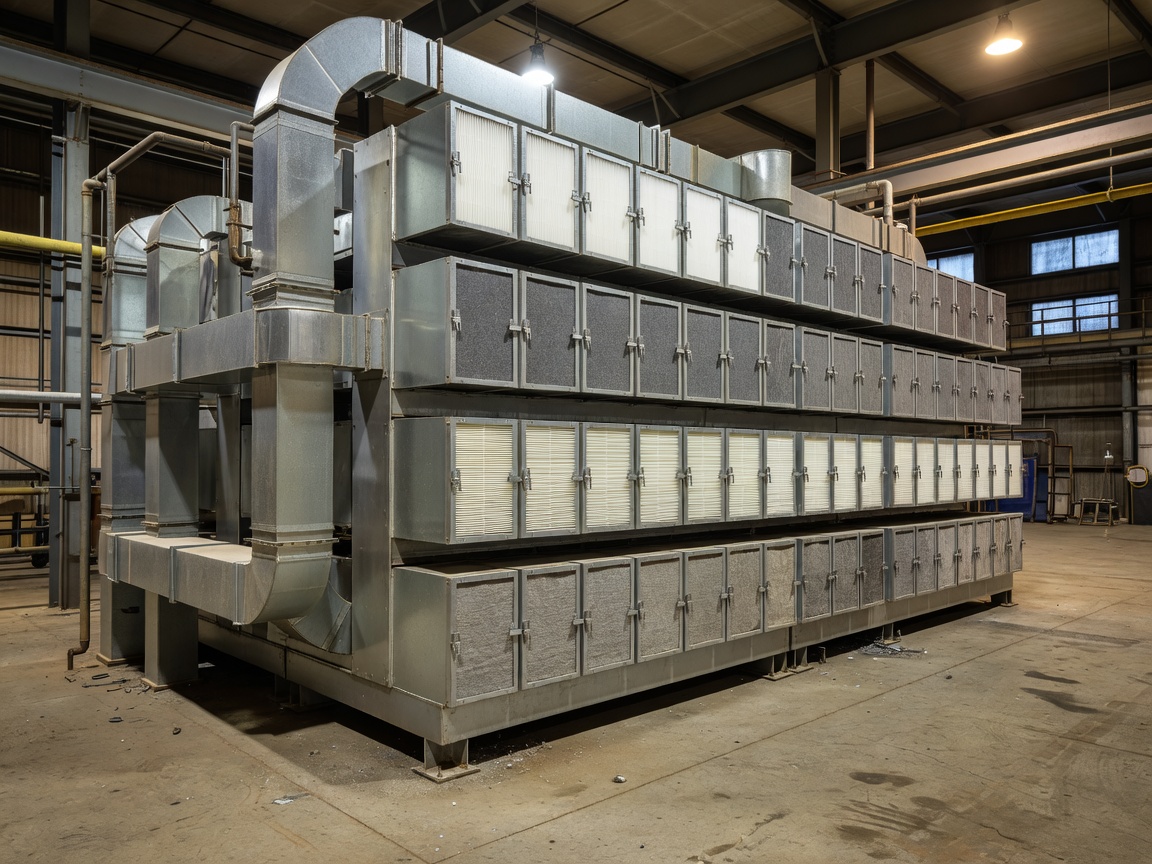
Air Filtration Systems
Extracting air is only half the battle. To truly control dust and particulates, industrial filtration must be staged correctly, matching the right filter categories to your specific airborne contaminants.
Understanding Filtration Stages
A common mistake in facility management is relying on a single type of filter to do everything. Efficient industrial filtration requires a multi-staged approach. If you throw a highly sensitive HEPA filter directly into a heavy dust stream, it will blind (clog) within hours. Filtration stages are designed to progressively step down the particle size.
Typically, a system begins with coarse pre-filters to catch large debris and heavy dust. Once the large particulate control is achieved, the air moves through secondary fine filters, and finally to absolute filters if the process requires ultra-clean air. This staged approach extends the life of the more expensive downstream media.
Filter Categories and Selection Criteria
Selecting the right media depends entirely on what you are trying to capture. Filter categories are generally broken down by their efficiency ratings. You wouldn't use the same filter for wood dust as you would for welding fumes. The selection criteria must account for the nature of the particulate: is it dry, sticky, oily, or combustible?
- Panel and Pleated Filters: Standard for initial dust and particulate control.
- Bag / Pocket Filters: Offer deep loading capacity for higher concentrations of fine dust.
- Cartridge Collectors: Ideal for heavy industrial loads, often equipped with pulse-jet cleaning mechanisms.
- Activated Carbon: Necessary when removing VOCs, gases, and odours rather than solid particles.
Filter Placement and Pressure Considerations
Where you put the filter matters just as much as what kind of filter it is. Filter placement should occur in locations where the airflow velocity allows for optimal capture without causing excessive turbulence. However, every filter added to a system creates resistance.
These pressure considerations are crucial for system compatibility. As filters load with dirt, the pressure drop across them increases. If your fans aren't rated to handle that increased static pressure, overall airflow will plummet. This is why you cannot simply upgrade to a "better" filter without verifying that your ventilation fans can push air through the tighter weave.
Replacement Planning and Maintenance
Filtration is an ongoing consumable cost. Effective replacement planning relies on monitoring the pressure drop across the filter banks. Relying on visual inspection alone is insufficient—by the time a filter looks entirely blocked, it has likely been severely restricting airflow and wasting fan energy for weeks.
Integrating pressure gauges and linking them to your monitoring systems allows for condition-based maintenance, ensuring filters are changed precisely when needed—optimizing both air quality and budget.
Are your filters properly specified?
Our specialists can review your current filtration stages and recommend optimal media for your specific particulate load.
Consult with a Filtration Expert